Showing posts with label Mayan Civilisation. Show all posts
Showing posts with label Mayan Civilisation. Show all posts
Sunday, 19 September 2010
Mayan Civilisation : Apocalypto Trailer
Set in the Mayan civilization, when a man's idyllic presence is brutally disrupted by a violent invading force, he is taken on a perilous journey to a world ruled by fear and oppression where a harrowing end awaits him. Through a twist of fate and spurred by the power of his love for his woman and his family he will make a desperate break to return home and to ultimately save his way of life.

Saturday, 18 September 2010
Mayan Civilisation : Calendar

The Maya kept time with a combination of several cycles that meshed together to mark the movement of the sun, moon and Venus. Their ritual calendar, known as the Tzolkin, was composed of 260 days. It pairs the numbers from 1 through 13 with a sequence of the 20 day-names shown below. It works something like our days of the week pairing with the numbers of the month. Thus you might have 1-Imix (similar to Sunday the 1st) followed by 2-Ik (just as you would have Monday the 2nd). When you get to 13-Ben, the next day would start the numbers over again, thus 1-Ix, 2-Men etc. It will take 260 days before the cycle gets back to 1-Imix again (13 x 20).
THE 20 DAY CYCLE
The symbols shown below represent the 20 day-names and are identified with their Yucatec names, pronunciation and approximate translation. The name, meaning and symbol can vary in different Maya languages. Also, each day can be represented with more elaborate glyphs known as "Head Variants" - a formal writing system which can be loosely compared to our script alphabet versus our print alphabet.
The Tzolkin calendar was meshed with a 365-day solar cycle called the "Haab". The calendar consisted of 18 months with 20 days (numbered 0-19) and a short "month" of only 5 days that was called the Wayeb and was considered to be a dangerous time. It took 52 years for the Tzolkin and Haab calendars to move through a complete cycle.
These are the Mayan words for periods of time:
Day = Kin (keen)
Month of 20 days = Uinal (wee nal)
Year of 360 days = Tun (toon)
20 Tuns = K'atun (k' ah toon)
20 K'atuns = Baktun (bock toon)
http://www.criscenzo.com
Mayan Civilisation : Numbers

Above you will find a sample of how the Maya could write numbers of any size using only three symbols, the dot, bar and a shell to represent zero.
http://www.criscenzo.com/jaguarsun/numbers
Mayan Civilisation : Gods and Deities
There is a vast pantheon of gods worshiped by the Maya. Different areas had different gods, and some were more important in one area than in another. Each location would also have it's special patron god. There was probably some sense of competitiveness between locations, where they felt that their patron god was stronger or more beneficent that others. When one area overtook another through war or politics, they would impose the worship of their favorite gods on their subjects.
Some of the gods that archaeologists and anthropologists have identified are:
Hunab Ku
The supreme diety - the creator god
Cizin
Death god - (an ancient god of violent sacrifice, such as decapitation
Chac
Rain god -rain & lightning
Itzamna
Aged god - priestly knowledge, divination, writing
Hun Hunahpu
Maize god - (one of the Hero twins)
Xbalanque
(pronouced schpah-len-kay) The other Hero Twin of the "Popol Vuh" - the Maya creation story
Kin or Kinich Ahau
Sun god - a younger version of Itzamna
Ik
Wind & Hurricane god
Chack Chel or Ixchel
Old Goddess - fearsome genetrix - Old Goddess of fertility and birth. Rainbow Goddess -patron of weavers
Young Moon Goddess
Patron of fertility and love
Kawil
(pronounced Kah-wheel) God of Rulers - patron of dynastic descent, fire & lightning (also called Bolon Dzacab)
Jaguar gods
Lords of the underworld - associated with caves, night, hunting (shamans often are depicted transforming into jaguars. The Olmec - worshiped were-jaguars - a combination of human and jaguar
Ek Chuah
Patron of merchants
Pauahtun
4 gods who hold up the sky
Hun Batz & Hun Chuen
(monkey gods) Patrons of scribes
http://www.criscenzo.com
Some of the gods that archaeologists and anthropologists have identified are:
Hunab Ku
The supreme diety - the creator god
Cizin
Death god - (an ancient god of violent sacrifice, such as decapitation
Chac
Rain god -rain & lightning
Itzamna
Aged god - priestly knowledge, divination, writing
Hun Hunahpu
Maize god - (one of the Hero twins)
Xbalanque
(pronouced schpah-len-kay) The other Hero Twin of the "Popol Vuh" - the Maya creation story
Kin or Kinich Ahau
Sun god - a younger version of Itzamna
Ik
Wind & Hurricane god
Chack Chel or Ixchel
Old Goddess - fearsome genetrix - Old Goddess of fertility and birth. Rainbow Goddess -patron of weavers
Young Moon Goddess
Patron of fertility and love
Kawil
(pronounced Kah-wheel) God of Rulers - patron of dynastic descent, fire & lightning (also called Bolon Dzacab)
Jaguar gods
Lords of the underworld - associated with caves, night, hunting (shamans often are depicted transforming into jaguars. The Olmec - worshiped were-jaguars - a combination of human and jaguar
Ek Chuah
Patron of merchants
Pauahtun
4 gods who hold up the sky
Hun Batz & Hun Chuen
(monkey gods) Patrons of scribes
http://www.criscenzo.com
Mayan Civilisation : Overview
INTRODUCTION
Of the many pre-Columbian civilizations of the western hemisphere, the Maya civilization alone developed a writing system that provided a complete expression of their language, thus they are the only indigenous people of the Americas with a written history. While only four of their folding-bark books survived the fanatical purges of the Spanish priests, their writings in stucco, stone and pottery remain. But the voices of the ancient Maya stood silent for centuries, waiting for the advances in decipherment made in the past three decades.
WHAT DEFINES THE MAYA?
The Maya civilization was never united under one governing body like the Aztec. Instead, independent city-states shared many traits and beliefs that categorized them as Maya. In addition to their writing system, they had a calendar system that consisted of a Long Count divided into five cycles, along with a 260 day ritual cycle and a 365 day solar calendar. They had a comprehensive knowledge of naked-eye astronomy and charted the movements of the moon, Mercury, Venus, Mars, Jupiter and the constellations through the night sky, and marked the position of the sun along the horizon.
A UNIQUE VIEW OF THE UNIVERSE
The ancient Maya had a complex pantheon of deities whom they worshipped and offered human sacrifices. Rulers were believed to be descendants of the gods and their blood was the ideal sacrifice, either through personal bloodletting or the sacrifice of captives of royal blood. The Maya vision of the universe is divided into multiple levels, above and below earth, positioned within the four directions of north, south, east and west. After death, the soul was believed to go to the Underworld, Xibalba (shee bal bah), a place of fright where sinister gods tested and tricked their unfortunate visitors.
AGRICULTURE AND DIET
While the Maya diet varies, depending on the local geography, maize remains the primary staple now as it was centuries ago. Made nutritionally complete with the addition of lime, the kernels are boiled, ground with a metate and mano, then formed by hand into flat tortillas that are cooked on a griddle that is traditionally supported on three stones. Chile peppers, beans and squash are still grown in the family farm plot (milpa) right along with the maize, maximizing each crop's requirements for nutrients, sun, shade and growing surface. Agriculture was based on slash and burn farming which required that a field be left fallow for 5 to 15 years after only 2 to 5 years of cultivation. But there is evidence that fixed raised fields and terraced hillsides were also used in appropriate areas.
ARCHITECTURE
Limestone structures, faced with lime stucco, were the hallmark of ancient Maya architecture. The Maya developed several unique building innovations, including the corbel arch which was a false arch achieved by stepping each successive block, from opposite sides, closer to the center, and capped at the peak. Tombs were often encased within or beneath Maya structures. Frequently new temples were built over existing structures. A honeycombed roofcomb towered above many structures, providing a base for painted plaster that was the Maya equivalent of the billboard. In addition to temples, most Maya sites had multi-roomed structures that probably served as royal palaces as well as centers for government affairs. Historically significant events, such as accessions, the capture or sacrifice of royal victims and the completion of the twenty year katun cycle, were recorded on stone stelae and tablets.
SOCIAL STRUCTURE
There was a distinct class system in ancient Maya times. Between the ruling class and the farmer/laborer, there must have been an educated nobility who were scribes, artists and architects. Evidence of their skill and innovation remains in works of stone, stucco, jade, bone, pottery, obsidian and flint. There is no evidence of a priesthood and it is likely that priestly duties were performed by the ruler.
http://www.criscenzo.com
Of the many pre-Columbian civilizations of the western hemisphere, the Maya civilization alone developed a writing system that provided a complete expression of their language, thus they are the only indigenous people of the Americas with a written history. While only four of their folding-bark books survived the fanatical purges of the Spanish priests, their writings in stucco, stone and pottery remain. But the voices of the ancient Maya stood silent for centuries, waiting for the advances in decipherment made in the past three decades.
WHAT DEFINES THE MAYA?
The Maya civilization was never united under one governing body like the Aztec. Instead, independent city-states shared many traits and beliefs that categorized them as Maya. In addition to their writing system, they had a calendar system that consisted of a Long Count divided into five cycles, along with a 260 day ritual cycle and a 365 day solar calendar. They had a comprehensive knowledge of naked-eye astronomy and charted the movements of the moon, Mercury, Venus, Mars, Jupiter and the constellations through the night sky, and marked the position of the sun along the horizon.
A UNIQUE VIEW OF THE UNIVERSE
The ancient Maya had a complex pantheon of deities whom they worshipped and offered human sacrifices. Rulers were believed to be descendants of the gods and their blood was the ideal sacrifice, either through personal bloodletting or the sacrifice of captives of royal blood. The Maya vision of the universe is divided into multiple levels, above and below earth, positioned within the four directions of north, south, east and west. After death, the soul was believed to go to the Underworld, Xibalba (shee bal bah), a place of fright where sinister gods tested and tricked their unfortunate visitors.
AGRICULTURE AND DIET
While the Maya diet varies, depending on the local geography, maize remains the primary staple now as it was centuries ago. Made nutritionally complete with the addition of lime, the kernels are boiled, ground with a metate and mano, then formed by hand into flat tortillas that are cooked on a griddle that is traditionally supported on three stones. Chile peppers, beans and squash are still grown in the family farm plot (milpa) right along with the maize, maximizing each crop's requirements for nutrients, sun, shade and growing surface. Agriculture was based on slash and burn farming which required that a field be left fallow for 5 to 15 years after only 2 to 5 years of cultivation. But there is evidence that fixed raised fields and terraced hillsides were also used in appropriate areas.
ARCHITECTURE
Limestone structures, faced with lime stucco, were the hallmark of ancient Maya architecture. The Maya developed several unique building innovations, including the corbel arch which was a false arch achieved by stepping each successive block, from opposite sides, closer to the center, and capped at the peak. Tombs were often encased within or beneath Maya structures. Frequently new temples were built over existing structures. A honeycombed roofcomb towered above many structures, providing a base for painted plaster that was the Maya equivalent of the billboard. In addition to temples, most Maya sites had multi-roomed structures that probably served as royal palaces as well as centers for government affairs. Historically significant events, such as accessions, the capture or sacrifice of royal victims and the completion of the twenty year katun cycle, were recorded on stone stelae and tablets.
SOCIAL STRUCTURE
There was a distinct class system in ancient Maya times. Between the ruling class and the farmer/laborer, there must have been an educated nobility who were scribes, artists and architects. Evidence of their skill and innovation remains in works of stone, stucco, jade, bone, pottery, obsidian and flint. There is no evidence of a priesthood and it is likely that priestly duties were performed by the ruler.
http://www.criscenzo.com
Friday, 17 September 2010
Mayan Civilisation : Architecture


From top to bottom:
1. A late bloomer in the Maya world, the city of Uxmal in Mexico’s Yucatán Peninsula continued to flourish in all its splendor after the fall of Tikal, Palenque, and the other great cities to the south in the ninth century. A ruin with ornate roof combs known as the House of the Doves showcases the Puuc architectural style, named for the hills of the northern Yucatán Peninsula.
2. Set into the side of a mountain in southern Mexico, the elegant site of Palenque marks the western extent of the Maya territory. Many of its structures were built by the king known as Pakal, who was interred deep within the Temple of the Inscriptions (at left) with one of the greatest caches of jade ornaments yet found in a Maya burial. Allied with Tikal, the city faded around A.D. 800 after it was defeated by Toniná, in league with Tikal’s rival Calakmul.
3. With Polaris as a hub, stars streak through the night in a time exposure of the House of the Magician at Uxmal. Sophisticated sky watchers, the Maya tracked the movements of the stars and planets closely and created an accurate solar-year calendar based on their observations. The heavens also had metaphysical significance for the Maya. They believed the Milky Way was the path to Xibalba, the underworld, and they scheduled momentous events such as battles and sacrifices around the journeys of Venus and perhaps Jupiter.
4. Kabáh, in the Yucatán, shares the same ornate architectural style seen at Uxmal, to which it is connected by a sacbe, or stone causeway. Its most famous monument, the Palace of the Masks, displays 260 images of Chac, the long-nosed rain god. Repeated on many buildings in this arid site, this motif was likely meant to summon rain. The snouts could have held offerings of copal, the sacred incense.
5. The Temple of the Warriors projects a message of power at Chichén Itzá, which flourished as a trading center past the year 1000, long after cities to the south had fallen. Murals inside the temple show merchandise moving by land and sea, and the square columns outside bear armed figures with feathered headdresses.
6. A pyramid called La Iglesia (The Church) soars into the canopy of the rain forest at Cobá, in the Yucatán. Only a fraction of this little-known site’s 30 square miles (78 square kilometers) has been cleared of the tangled cover that overtook all Maya cities, and few visitors arrived until the promise of tourism brought a road in the 1970s. Now day-trippers from resorts on Mexico’s Caribbean coast climb the crumbling ruins, once reserved for priests and kings with godlike powers.
Mayan Civilisation : Sculptures and Objects


From top to bottom:
1. The death mask of Pakal, the great lord of Palenque, immortalizes the vigor of his youth with 340 pieces of jade, four pieces of shell, and two pieces of obsidian, most likely arranged on a wooden backing that has since rotted away. Inscriptions record that Pakal spent eight years of his seven-decade reign preparing his lavish burial. When he died, on August 28, A.D. 683, he was laid to rest laden with jade—this mask, a large pendant, earplugs, rings, necklaces, and bracelets—beneath a temple where he would be venerated for generations to come.
2. An incense burner’s ornate lid takes the shape of a warrior outfitted in Teotihuacan style, with a butterfly nosepiece and a helmet shaped like a bird—most probably an eagle. Many such objects have come to light near the modern town of Escuintla in southern Guatemala, where Teotihuacanos appear to have settled among the Maya.
3. Objects such as this jade vessel crowned by the likeness of a king—Jasaw Chan Kawiil II of Tikal—testify to the Maya’s artistic skills and their far-flung commerce. Luxuries for the elite—including jade, the pelts of exotic animals, and brilliant feathers—were traded throughout the region and into central Mexico.
4. A vessel from cacao country, the Pacific coast of Guatemala, takes the shape of a goddess personifying the cacao tree, with pods sprouting from her much as they do from the trunk of the tree. Real cacao pods contain rows of slippery white seeds, or beans. The Maya used the beans as money and made them into a bitter, spicy drink that the nobles quaffed during ceremonies. Today the beans are fermented, dried, and ground to make cocoa and chocolate.
5. A helmeted dwarf, crafted in about A.D. 600, was discovered in a royal tomb at the site of Waka, in northern Guatemala, along with 22 other figurines—dwarfs, courtiers, ball players, a shaman, a queen, and a king. Archaeologists believe the burial belonged to a ruler who may have been named Tzih Bahlam (Emergent Jaguar). “The figurines appear to represent a court scene of conjuring, appropriate for sending the soul of the deceased to his ancestors,” says Southern Methodist University’s David Freidel, the site’s lead archaeologist. “They could be ancestral figures, or the contemporary court.”
6. Sitting on a stool of bones, an aged god holds a human head in his hands. This spooky ceramic incense burner comes from the early fifth-century tomb of Tikal’s King Yax Nuun Ayiin—son of Spear-thrower Owl, the man who masterminded Teotihuacan’s incursion into Maya territory. When the burner was filled with smoldering incense, smoke issuing from the god’s mouth enveloped the head. The figure may represent a creator god breathing life into a human head.
7. Played in every city, large or small, the Maya ball game required heavy padding for competitors who hit a heavy rubber ball around a large court using just their upper arms and thighs. Often played with two teams of two or three members, the game was sometimes seen as representing the movements of the sun, the moon, and the planet Venus. It was also a metaphor for a mythical contest involving the maize god and characters known as the Hero Twins. At its most desperate, it became a ritual replaying of war, and matches ended with the beheading of the losers.
8. Wearing the sarong associated with the moon goddess, the divine essence of beauty and fertility, a young woman positions a lidded jar to pour a drink—perhaps the spicy chocolate favored by the Maya elite. Her elongated head reflects the custom of shaping the skull from birth to resemble an ear of corn, the sacred substance from which the Maya believed all humans were created. Likely buried with someone important, this figurine was meant to offer sustenance to the deceased for eternity.
Mayan Civilisation : Carvings


From top to bottom:
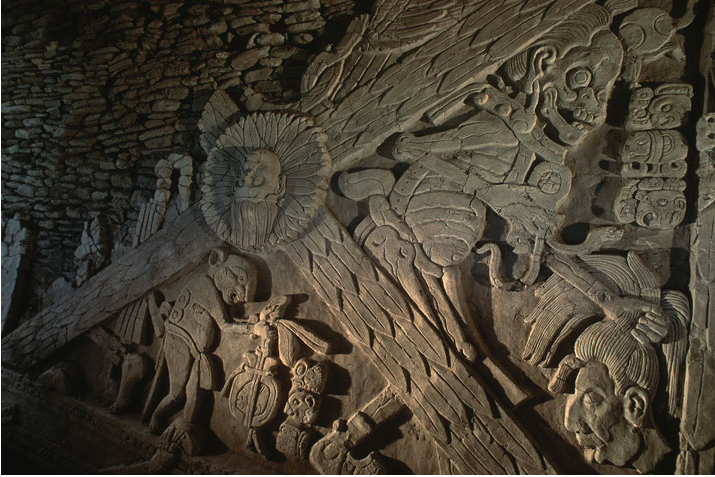
1. Commissioned by a Tikal ruler named Stormy Sky, an inscribed stone pillar known as Stela 31 tells of Fire Is Born’s arrival years before—and the death that same day of Tikal’s king, surely ordered by the conquering warlord. When this monument was discovered in 1960, Maya writing was just starting to be deciphered, so Fire Is Born’s name glyph (above left) was first read as Smoking Frog—a simple description of the design. Since then the Maya code has been cracked more fully, and Stela 31 has revealed its long-held secrets.
2. In a terrifying expression of royal power, a stucco mural at Toniná shows a turtle-footed skeleton grabbing the hair of a severed head—with portrait-like features, perhaps of a real person—and a mythical rodent holding another head in a ritual bundle. These characters were the wayob, the affliction-spewing alter egos of kings that were used to curse enemies. They work here amid a scaffold bearing the heads of human sacrifices.
3. One of the last great kings of Cancuén, Taj Chan Ahk, presides over a ceremony in September A.D. 795 on a recently uncovered masterpiece of Maya art. With hundreds of sites still to be investigated, many more such testaments to the glory of the Maya civilization await discovery.
Thursday, 9 September 2010
Mayan Civilisation : Eyewitness Travel

'If you like your Mayan sites tame and manageable, Mexico's Chichen Itza fits the bill, but if you prefer your ruins living, breathing and vertigo-inducing, it has to be Tikal'
If Tikal were a volcano, it would be on perpetual amber alert. You tell yourself that nothing's going to happen whilst you're there, but then again, once there, suddenly you're not so sure. Perhaps it's incessant chattering, rustling wildlife or the feeling that the on-site archaeologists are on the verge of unearthing something spectacular, but this ancient site has the air of a place about to rumble into action at any moment. Whereas better known Chichen Itza can feel a little like a historical theme park, Tikal's winding jungle pathways and remote location combine with its sheer scale to devastating hairs-on-the-back-of-your-neck effect.
At one time the epicentre of the Mayan Civilisation, the city of Tikal dominated Mesoamerica in the 6th Century AD, during the region's late classic period. The most impressive of Tikal's structures are its six huge stone step pyramids, known as Temples I-VI, some of which tower over 61m (200ft) above the humble tourist. Yet the majesty of Tikal is apparent wherever you are, whether you are craning your neck upwards, peering giddily downwards, or gazing across the Plaza Mayor at the temple tops rising above the rainforest canopy.
Much of Tikal remains unexcavated, unlike Chichen Itza, which was fully cleared in the 1930s and is all the catalogued, on a plate. Tikal leaves much more to the imagination - its ancient ruins are always keeping something back, whether shrouded in dawn mist or covered in tropical foliage. And when you've found yourself a spot in which to sit and take it all in, Tikal allows you to believe that if you closed your eyes and drifted into a daydream, you might open them again too find yourself in the midst of a Mayan ceremony; an ancient ball game, perhaps, or a shamanic ritual. It's almost as though the Maya had downed tools and left this, their largest city, just hours before your arrival.
While Chichen Itza has played home to concerts, Tikal has played host to sacred rituals and traditions since the 1990s. During modern Mayan ceremonies, huge fires are lit in Plaza Mayor, and the spirits are recalled to this once powerful citadel, which to this day, although ruined, is far from being spoilt
Thursday, 19 August 2010



Tuesday, 17 August 2010
Mayan Civilisation : Map

The Maya culture flourished and continues to exist in a region of Mexico and Central America often referred to as Mesoamerica. This encompasses the Yucatan peninsula, the Tabasco and Chiapas regions of present day Mexico, Guatemala, Belize and the western parts of Honduras and El Salvador. Geographically the region is broken into the lowlands and the highlands.
THE LOWLANDS
The lowlands are a limestone shelf bordered on the north and west by the Gulf of Mexico and on the east by the Caribbean Sea. The northern lowland climate is hot, and the rainy season, from May through October, often brings insufficient rainfall. Permanent rivers and lakes are virtually nonexistent and only cenotes (large sinkholes filled with rainwater), provide precious water. The southern lowlands consist of rainforest and savannas where lakes and rivers are fed by the mighty Usumacinta River.
THE HIGHLANDS
The highlands are a wide swathe of mountains and valleys of the Sierra Madre, bounded on the south by a narrow coastal plain and the Pacific Ocean. Although subject to tsunamis, volcanoes and earthquakes, the soil is fertile and the climate pleasantly cooler than the lowlands. The rainy season is between May and November, with peak rainfall in June and October.
CULTURAL DIVISIONS
Culturally the area is divided into three sections: the northern, central and southern regions. The earliest evidence of the Maya civilization is found in the southern region. At Izapa carvings depict gods that were the precursors of the Classic deities and at Kaminaljuyú glyphs on stelea foreshadow the Maya writing system. The area was clearly influenced by the Olmec.
The central region includes the southern lowlands, from Tabasco in the Northwest to Belize and Guatemala's Motagua River region in the southeast. Here is where the Classic Maya flourished, along the Usumacinta River and throughout the Petén.
The northern region, which encompasses the northern lowlands, was populated by the Maya in the Late Classic period, when influence from central Mexico created a hybrid Maya/Toltec culture, and was home to the Maya well into the Post-Classic period.
Mayan Civilisation : National Geographic pt2
THE COLLAPSE
Fatal Rivalries
One day in the year 800, the peaceful Maya city of Cancun reaped the whirlwind. King Kan Maax must have known that trouble was coming, for he had tried to build makeshift breastworks at the approaches to his 200-room palace. He didn't finish in time.
The attackers quickly overran the outskirts of the city and streamed into Cancun's ritual heart. The speed of the attack is obvious even today. Unfinished construction projects lay in tumbled heaps. Half-carved stone monuments littered the pathways. Pots and bowls were strewn about the palace kitchen.
The invaders took 31 hostages. The jewels and ornaments found with their remains marked them as nobles, perhaps members of Kan Maax's extended family or royal guests from stricken cities elsewhere. The captives included women and children; two of the women were pregnant.
All were led to the ceremonial courtyard of the palace and systematically executed. The killers wielded spears and axes, impaling or decapitating their victims. They laid the corpses in the palace's cistern. Roughly 30 feet (nine meters) long and 10 feet (three meters) deep, it was lined with red stucco and fed by an underground spring. The bodies, accompanied by ceremonial garments and precious ornaments, fit easily. Kan Maax and his queen were not spared. They were buried a hundred yards (90 meters) away in two feet (0.6 meters) of construction fill intended for remodeling the palace. The king still wore his elaborate ceremonial headdress and a mother-of-pearl necklace identifying him as Holy Lord of Cancun.
No one knows who the killers were or what they sought. Booty apparently did not interest them. Some 3,600 pieces of jade, including several jade boulders, were left untouched; household goods in the palace and ceramics in Cancuén's giant kitchen were undisturbed. But to archaeologists who have dug up the evidence over the past several years, the invaders' message is clear. By depositing the bodies in the cistern, "they poisoned the well," says Vanderbilt University archaeologist Arthur Demarest. They also chipped the faces from all the carved likenesses on Cancuén's stone monuments and pushed them over, facedown. "The site," says Demarest, "was ritually killed."
CANCUÉN WAS ONE OF the last major dominoes to fall in the Pasión River Valley, part of the ancient Maya heartland in present-day Guatemala. Many other cities had already met similarly decisive ends, and throughout the southern lowlands of Mesoamerica, what came to be known as the collapse of the Classic Maya was well under way. The civilization that had dominated the region for 500 years was sliding into a prolonged, irrevocable decline.
While warfare obliterated some vibrant city-states, others simply faded. The kuhul ajaw, or holy lords, who had celebrated their every deed in murals, sculpture, and architecture, no longer commissioned new works. Public displays of hieroglyphic writing became scarce, and dates in the Long Count calendar system all but disappeared from onuments. Population fell drastically. Nobles abandoned palaces and squatters moved in, lit cook fires in the old throne rooms, and built lean-tos next to crumbling walls. And then even the squatters left, and the jungle reclaimed what remained.
Elsewhere in the Petén lowlands of Guatemala and in southern Mexico, the collapse took longer. Even as Cancuén fell, rulers of the great city-state of Tikal in the northern Petén were building ceremonial structures. But 30 years later Tikal's population began to drop precipitously as well. Its last dated monument was inscribed in 869. By 1000, the Classic Maya had ceased to exist.
The question has fascinated scholars and the public since 19th-century explorers began discovering "lost cities" in the Petén: How could one of the ancient world's great civilizations simply dissolve?
Early speculation centered on sudden catastrophe, perhaps volcanism or an earthquake or a deadly hurricane. Or perhaps it was a mysterious disease, untraceable today—something like the Black Death in medieval Europe or the smallpox that wiped out Native American populations at the dawn of the colonial age. Modern researchers have discarded these one-event theories, however, because the collapse extended over at least 200 years. "There isn't any single factor that everybody agrees on," says Southern Illinois University's Prudence M. Rice.
Scholars have looked instead at combinations of afflictions in different parts of the Maya world, including overpopulation, environmental damage, famine, and drought. "You come away feeling that anything that can go wrong did," says Rice.
They have also focused on the one thing that appears to have happened everywhere during the prolonged decline: As resources grew scarce, the kuhul ajaw lost their divine luster, and, with it, the confidence of their subjects, both noble and commoner. Instability and desperation in turn fueled more destructive wars. What had been ritualized contests fought for glory or captives turned into spasms of savagery like the one that obliterated Cancuén. Says Simon Martin of the University of Pennsylvania Museum: "The system broke down and ran out of control."
For more than a millennium, the Maya had entrusted their religious and temporal well-being to their god-kings. These leaders displayed their might and majesty in lavish rituals and pageants, in opulent art and architecture, and in written records of their triumphs, inscribed on stone, murals, and ceramics.
The system prospered—indeed, its excesses created the artistic achievements and learning that defined the Maya as one of the ancient world's great cultures—as long as the land could satisfy people's basic needs. This was easy at first when cities were small and resources relatively plentiful, but over time, growing populations, an expanding nobility, and rivalry between the city-states strained the limits of the environment.
Today the Petén, geographically the largest province in Guatemala, has a population of 367,000, living in isolated towns scattered through a forested wilderness. In the eighth century, by some estimates, ten million people lived in the Maya lowlands. The landscape was an almost unbroken fabric of intensely cultivated farms, gardens, and villages, linked by a web of trails and paved causeways connecting monumental city-states.
Maya farmers were well schooled in sophisticated techniques designed to get maximum production from delicate tropical soils. But beginning in the ninth century, studies of lake-bed sediments show, a series of prolonged droughts struck the Maya world, hitting especially hard in cities like Tikal, which depended on rain both for drinking water and to reinvigorate the swampland bajos where farmers grew their crops. River ports like Cancuén might have escaped water shortages, but across much of the Maya region the lake-bed sediments also show ancient layers of eroded soil, testimony to deforestation and overuse of the land.
When bad times came, there was little the kuhul ajaw could do to help their people. Monoculture farming—growing one staple food crop that could be accumulated and stored for hard times or for trade—could not be sustained in the rain forest. Instead, each city-state produced small quantities of many different food items, such as maize, beans, squash, and cacao. There was enough, at least at first, to feed the kingdom, but little left over.
Meanwhile, Maya society was growing dangerously top heavy. Over time, elite polygamy and intermarriage among royal families swelled the ruling class. The lords demanded jade, shells, feathers from the exotic quetzal bird, fancy ceramics, and other expensive ceremonial accoutrements to affirm their status in the Maya cosmos. A king who could not meet the requirements of his relatives risked alienating them.
The traditional rivalry among states only made matters worse. The kuhul ajaw strove to outdo their neighbors, building bigger temples and more elegant palaces and staging more elaborate public pageants. All of this required more labor, which required larger populations and, perhaps, more wars to exact tribute in forced labor from fallen enemies. Overtaxed, the Maya political system began to falter.
The greatest rivalry of all helped propel the Classic Maya to their peak—and then tore their world apart. Beginning in the fifth century, the city-state of Tikal, probably bolstered by an alliance with the great Mexican highland state of Teotihuacan, expanded its influence, enlisting allies and vassal states in a swath southward through the Pasión River Valley to Copán in what is now Honduras. A century later a challenger arose: The northern city-state of Calakmul, in what is now the Mexican lowlands of Campeche, forged an alliance of city-states throughout the Petén, north to the Yucatán and east to what is now Belize. The two great alliances faced off in a rivalry that lasted more than 130 years.
This period marked the golden age of Classic Maya civilization. The kuhul ajaw were in full flower in these two great alliances, competing in art and monuments as well as in frequent but limited wars. Calakmul defeated Tikal in a major battle in 562 but destroyed neither the city nor its population. Eventually Tikal rebounded and defeated Calakmul, subsequently building many of its most spectacular monuments.
Simon Martin, with Nikolai Grube of the University of Bonn, compares the Tikal-Calakmul rivalry to the superpower struggle of the 20th century, when the U.S. and the Soviet Union competed to outdo each other in fields ranging from weaponry to space travel. With neither side ever able to gain the upper hand, the Cold War arguably brought stability, and so did the standoff in the Maya world. "There was a certain degree of destruction" because of the rivalry, says Guatemalan archaeologist Héctor Escobedo. "But there was also equilibrium."
It did not last. Martin suggests the balance may have been intrinsically unstable, like the competition among the city-states of ancient Greece, or the nervous grappling between North and South in the United States prior to the Civil War. Or perhaps an overstressed environment finally caught up with the proud Maya powers, bringing a new edge of desperation to their rivalry. Either way, the unraveling began at the small garrison state of Dos Pilas, near the Pasión River downstream of Cancuén.
In 630 Tikal, trying to reassert a presence along Pasión River trade routes increasingly dominated by Calakmul, expanded an existing outpost near two large springs—pilas, in Spanish. The site had little else to recommend it. Dos Pilas grew no crops and sold nothing. Scholars call it a "predator state" that depended on tribute from the surrounding countryside. War, for Dos Pilas, was not only a ritual to glorify kings and appease gods. War was what Dos Pilas did to survive.
The kingdom's history of violence and duplicity began when Tikal installed one of its princes, Balaj Chan Kawiil, as Dos Pilas's ruler in 635. The garrison slapped together a fancy-looking capital for the young prince, using carved facades to mask loose and unstable construction fill. But in 658 Calakmul overran Dos Pilas and drove Balaj Chan Kawiil into exile.
We know the next chapter thanks to a thunderstorm that toppled a tree at Dos Pilas six years ago, exposing a carved stairway hidden beneath its roots. Inscriptions on the stairway reveal that Balaj Chan Kawiil returned two years after his exile—but as a Calakmul surrogate. Dos Pilas's turncoat king helped Calakmul cement its control over the Pasión Valley during the next two decades. Then Calakmul delivered fateful news. Its rulers ordered Balaj Chan Kawiil to fight his brother in Tikal itself.
In 679 he attacked his native city. "Mountains of skulls were piled up, and blood flowed," the stairway records. Balaj Chan Kawiil triumphed, and his brother died in the battle. The victory brought Calakmul to apogee and transformed Dos Pilas into the overlord of the Petexbatún, the southwestern part of the Petén.
Tikal survived, rebuilt, and less than 20 years later attacked and defeated Calakmul. Stucco sculpture at Tikal's central acropolis depicts a Calakmul noble awaiting sacrifice. It was a defeat from which Calakmul never fully recovered, but Tikal itself was never the same after the wars finally concluded. "Even though Tikal wins in the end," says the University of Pennsylvania's Robert Sharer, "it's never in shape to control everything."
What happened next is not entirely clear. Calakmul's power was broken, yet its allies, including Dos Pilas, continued to battle Tikal in Calakmul's name. Dos Pilas consolidated its hegemony in the Petexbatún through alliances and war. Its rulers commissioned new monuments and built a second capital.
But in 761 Dos Pilas's luck ran out. Former allies and vassals conquered the city and sent its ruler into exile. Dos Pilas would never be resettled, and with its obliteration the Maya world crossed a divide. Instead of reestablishing order, wars would create greater disorder; instead of one ruler emerging triumphant from a decisive battle, each conflict simply created more pretenders. Victories, instead of inspiring new monuments and temples, were transient and, increasingly, unremarked. Defeats spurred desperate citizens to rip apart their ceremonial buildings, using the stones and fill to build redoubts in hopes of staving off future invaders. Cities no longer rebuilt and rebounded. They simply ceased to exist.
Smaller states tried to assert themselves in the spreading chaos, but none could. Instead, the warring states sought temporary advantage in a land of dwindling resources. The commoners probably hid, fled, or died.
For a time, fleeing nobles could find refuge in Cancuén, a quiet port at the headwaters of the Pasión River. Even as downriver cities sank into chaos during the eighth century, Cancuén prospered by trading luxury items and providing sumptuous lodgings for elite visitors. The architect of this golden age was King Taj Chan Ahk, who came to power in 757 at the age of 15. Cancuén had a long history as a strategic trading post, but Taj Chan Ahk transformed the city into a stunning ceremonial center. Its heart was a 270,000-square-foot (25,000 square meters), three-story royal palace with vaulted ceilings and 11 courtyards, made of solid limestone and elegantly placed on a riverside promontory. It was a perfect stage for a Maya god-king, and Taj Chan Ahk was master of the role, even as it was dying out elsewhere.
There is no evidence that Taj Chan Ahk ever fought a war or even won a battle. Instead he managed to dominate the upper Pasión Valley for nearly 40 years by coaxing advantage through patronage and alliances. An altar monument at Cancuén dated 790 shows him in action, engaged in a ceremonial ball game with an unknown noble, perhaps to celebrate a treaty or a state visit.
Taj Chan Ahk died in 795 and was succeeded by his son Kan Maax, who sought to trump his father by expanding the palace. But pomp and ritual—the old trappings of kingship—could no longer hold the Maya universe together. Within five years the spreading chaos had reached the gates of the city. In one terrible day its glory winked out, another light extinguished in the world of the Classic Maya.
Fatal Rivalries
One day in the year 800, the peaceful Maya city of Cancun reaped the whirlwind. King Kan Maax must have known that trouble was coming, for he had tried to build makeshift breastworks at the approaches to his 200-room palace. He didn't finish in time.
The attackers quickly overran the outskirts of the city and streamed into Cancun's ritual heart. The speed of the attack is obvious even today. Unfinished construction projects lay in tumbled heaps. Half-carved stone monuments littered the pathways. Pots and bowls were strewn about the palace kitchen.
The invaders took 31 hostages. The jewels and ornaments found with their remains marked them as nobles, perhaps members of Kan Maax's extended family or royal guests from stricken cities elsewhere. The captives included women and children; two of the women were pregnant.
All were led to the ceremonial courtyard of the palace and systematically executed. The killers wielded spears and axes, impaling or decapitating their victims. They laid the corpses in the palace's cistern. Roughly 30 feet (nine meters) long and 10 feet (three meters) deep, it was lined with red stucco and fed by an underground spring. The bodies, accompanied by ceremonial garments and precious ornaments, fit easily. Kan Maax and his queen were not spared. They were buried a hundred yards (90 meters) away in two feet (0.6 meters) of construction fill intended for remodeling the palace. The king still wore his elaborate ceremonial headdress and a mother-of-pearl necklace identifying him as Holy Lord of Cancun.
No one knows who the killers were or what they sought. Booty apparently did not interest them. Some 3,600 pieces of jade, including several jade boulders, were left untouched; household goods in the palace and ceramics in Cancuén's giant kitchen were undisturbed. But to archaeologists who have dug up the evidence over the past several years, the invaders' message is clear. By depositing the bodies in the cistern, "they poisoned the well," says Vanderbilt University archaeologist Arthur Demarest. They also chipped the faces from all the carved likenesses on Cancuén's stone monuments and pushed them over, facedown. "The site," says Demarest, "was ritually killed."
CANCUÉN WAS ONE OF the last major dominoes to fall in the Pasión River Valley, part of the ancient Maya heartland in present-day Guatemala. Many other cities had already met similarly decisive ends, and throughout the southern lowlands of Mesoamerica, what came to be known as the collapse of the Classic Maya was well under way. The civilization that had dominated the region for 500 years was sliding into a prolonged, irrevocable decline.
While warfare obliterated some vibrant city-states, others simply faded. The kuhul ajaw, or holy lords, who had celebrated their every deed in murals, sculpture, and architecture, no longer commissioned new works. Public displays of hieroglyphic writing became scarce, and dates in the Long Count calendar system all but disappeared from onuments. Population fell drastically. Nobles abandoned palaces and squatters moved in, lit cook fires in the old throne rooms, and built lean-tos next to crumbling walls. And then even the squatters left, and the jungle reclaimed what remained.
Elsewhere in the Petén lowlands of Guatemala and in southern Mexico, the collapse took longer. Even as Cancuén fell, rulers of the great city-state of Tikal in the northern Petén were building ceremonial structures. But 30 years later Tikal's population began to drop precipitously as well. Its last dated monument was inscribed in 869. By 1000, the Classic Maya had ceased to exist.
The question has fascinated scholars and the public since 19th-century explorers began discovering "lost cities" in the Petén: How could one of the ancient world's great civilizations simply dissolve?
Early speculation centered on sudden catastrophe, perhaps volcanism or an earthquake or a deadly hurricane. Or perhaps it was a mysterious disease, untraceable today—something like the Black Death in medieval Europe or the smallpox that wiped out Native American populations at the dawn of the colonial age. Modern researchers have discarded these one-event theories, however, because the collapse extended over at least 200 years. "There isn't any single factor that everybody agrees on," says Southern Illinois University's Prudence M. Rice.
Scholars have looked instead at combinations of afflictions in different parts of the Maya world, including overpopulation, environmental damage, famine, and drought. "You come away feeling that anything that can go wrong did," says Rice.
They have also focused on the one thing that appears to have happened everywhere during the prolonged decline: As resources grew scarce, the kuhul ajaw lost their divine luster, and, with it, the confidence of their subjects, both noble and commoner. Instability and desperation in turn fueled more destructive wars. What had been ritualized contests fought for glory or captives turned into spasms of savagery like the one that obliterated Cancuén. Says Simon Martin of the University of Pennsylvania Museum: "The system broke down and ran out of control."
For more than a millennium, the Maya had entrusted their religious and temporal well-being to their god-kings. These leaders displayed their might and majesty in lavish rituals and pageants, in opulent art and architecture, and in written records of their triumphs, inscribed on stone, murals, and ceramics.
The system prospered—indeed, its excesses created the artistic achievements and learning that defined the Maya as one of the ancient world's great cultures—as long as the land could satisfy people's basic needs. This was easy at first when cities were small and resources relatively plentiful, but over time, growing populations, an expanding nobility, and rivalry between the city-states strained the limits of the environment.
Today the Petén, geographically the largest province in Guatemala, has a population of 367,000, living in isolated towns scattered through a forested wilderness. In the eighth century, by some estimates, ten million people lived in the Maya lowlands. The landscape was an almost unbroken fabric of intensely cultivated farms, gardens, and villages, linked by a web of trails and paved causeways connecting monumental city-states.
Maya farmers were well schooled in sophisticated techniques designed to get maximum production from delicate tropical soils. But beginning in the ninth century, studies of lake-bed sediments show, a series of prolonged droughts struck the Maya world, hitting especially hard in cities like Tikal, which depended on rain both for drinking water and to reinvigorate the swampland bajos where farmers grew their crops. River ports like Cancuén might have escaped water shortages, but across much of the Maya region the lake-bed sediments also show ancient layers of eroded soil, testimony to deforestation and overuse of the land.
When bad times came, there was little the kuhul ajaw could do to help their people. Monoculture farming—growing one staple food crop that could be accumulated and stored for hard times or for trade—could not be sustained in the rain forest. Instead, each city-state produced small quantities of many different food items, such as maize, beans, squash, and cacao. There was enough, at least at first, to feed the kingdom, but little left over.
Meanwhile, Maya society was growing dangerously top heavy. Over time, elite polygamy and intermarriage among royal families swelled the ruling class. The lords demanded jade, shells, feathers from the exotic quetzal bird, fancy ceramics, and other expensive ceremonial accoutrements to affirm their status in the Maya cosmos. A king who could not meet the requirements of his relatives risked alienating them.
The traditional rivalry among states only made matters worse. The kuhul ajaw strove to outdo their neighbors, building bigger temples and more elegant palaces and staging more elaborate public pageants. All of this required more labor, which required larger populations and, perhaps, more wars to exact tribute in forced labor from fallen enemies. Overtaxed, the Maya political system began to falter.
The greatest rivalry of all helped propel the Classic Maya to their peak—and then tore their world apart. Beginning in the fifth century, the city-state of Tikal, probably bolstered by an alliance with the great Mexican highland state of Teotihuacan, expanded its influence, enlisting allies and vassal states in a swath southward through the Pasión River Valley to Copán in what is now Honduras. A century later a challenger arose: The northern city-state of Calakmul, in what is now the Mexican lowlands of Campeche, forged an alliance of city-states throughout the Petén, north to the Yucatán and east to what is now Belize. The two great alliances faced off in a rivalry that lasted more than 130 years.
This period marked the golden age of Classic Maya civilization. The kuhul ajaw were in full flower in these two great alliances, competing in art and monuments as well as in frequent but limited wars. Calakmul defeated Tikal in a major battle in 562 but destroyed neither the city nor its population. Eventually Tikal rebounded and defeated Calakmul, subsequently building many of its most spectacular monuments.
Simon Martin, with Nikolai Grube of the University of Bonn, compares the Tikal-Calakmul rivalry to the superpower struggle of the 20th century, when the U.S. and the Soviet Union competed to outdo each other in fields ranging from weaponry to space travel. With neither side ever able to gain the upper hand, the Cold War arguably brought stability, and so did the standoff in the Maya world. "There was a certain degree of destruction" because of the rivalry, says Guatemalan archaeologist Héctor Escobedo. "But there was also equilibrium."
It did not last. Martin suggests the balance may have been intrinsically unstable, like the competition among the city-states of ancient Greece, or the nervous grappling between North and South in the United States prior to the Civil War. Or perhaps an overstressed environment finally caught up with the proud Maya powers, bringing a new edge of desperation to their rivalry. Either way, the unraveling began at the small garrison state of Dos Pilas, near the Pasión River downstream of Cancuén.
In 630 Tikal, trying to reassert a presence along Pasión River trade routes increasingly dominated by Calakmul, expanded an existing outpost near two large springs—pilas, in Spanish. The site had little else to recommend it. Dos Pilas grew no crops and sold nothing. Scholars call it a "predator state" that depended on tribute from the surrounding countryside. War, for Dos Pilas, was not only a ritual to glorify kings and appease gods. War was what Dos Pilas did to survive.
The kingdom's history of violence and duplicity began when Tikal installed one of its princes, Balaj Chan Kawiil, as Dos Pilas's ruler in 635. The garrison slapped together a fancy-looking capital for the young prince, using carved facades to mask loose and unstable construction fill. But in 658 Calakmul overran Dos Pilas and drove Balaj Chan Kawiil into exile.
We know the next chapter thanks to a thunderstorm that toppled a tree at Dos Pilas six years ago, exposing a carved stairway hidden beneath its roots. Inscriptions on the stairway reveal that Balaj Chan Kawiil returned two years after his exile—but as a Calakmul surrogate. Dos Pilas's turncoat king helped Calakmul cement its control over the Pasión Valley during the next two decades. Then Calakmul delivered fateful news. Its rulers ordered Balaj Chan Kawiil to fight his brother in Tikal itself.
In 679 he attacked his native city. "Mountains of skulls were piled up, and blood flowed," the stairway records. Balaj Chan Kawiil triumphed, and his brother died in the battle. The victory brought Calakmul to apogee and transformed Dos Pilas into the overlord of the Petexbatún, the southwestern part of the Petén.
Tikal survived, rebuilt, and less than 20 years later attacked and defeated Calakmul. Stucco sculpture at Tikal's central acropolis depicts a Calakmul noble awaiting sacrifice. It was a defeat from which Calakmul never fully recovered, but Tikal itself was never the same after the wars finally concluded. "Even though Tikal wins in the end," says the University of Pennsylvania's Robert Sharer, "it's never in shape to control everything."
What happened next is not entirely clear. Calakmul's power was broken, yet its allies, including Dos Pilas, continued to battle Tikal in Calakmul's name. Dos Pilas consolidated its hegemony in the Petexbatún through alliances and war. Its rulers commissioned new monuments and built a second capital.
But in 761 Dos Pilas's luck ran out. Former allies and vassals conquered the city and sent its ruler into exile. Dos Pilas would never be resettled, and with its obliteration the Maya world crossed a divide. Instead of reestablishing order, wars would create greater disorder; instead of one ruler emerging triumphant from a decisive battle, each conflict simply created more pretenders. Victories, instead of inspiring new monuments and temples, were transient and, increasingly, unremarked. Defeats spurred desperate citizens to rip apart their ceremonial buildings, using the stones and fill to build redoubts in hopes of staving off future invaders. Cities no longer rebuilt and rebounded. They simply ceased to exist.
Smaller states tried to assert themselves in the spreading chaos, but none could. Instead, the warring states sought temporary advantage in a land of dwindling resources. The commoners probably hid, fled, or died.
For a time, fleeing nobles could find refuge in Cancuén, a quiet port at the headwaters of the Pasión River. Even as downriver cities sank into chaos during the eighth century, Cancuén prospered by trading luxury items and providing sumptuous lodgings for elite visitors. The architect of this golden age was King Taj Chan Ahk, who came to power in 757 at the age of 15. Cancuén had a long history as a strategic trading post, but Taj Chan Ahk transformed the city into a stunning ceremonial center. Its heart was a 270,000-square-foot (25,000 square meters), three-story royal palace with vaulted ceilings and 11 courtyards, made of solid limestone and elegantly placed on a riverside promontory. It was a perfect stage for a Maya god-king, and Taj Chan Ahk was master of the role, even as it was dying out elsewhere.
There is no evidence that Taj Chan Ahk ever fought a war or even won a battle. Instead he managed to dominate the upper Pasión Valley for nearly 40 years by coaxing advantage through patronage and alliances. An altar monument at Cancuén dated 790 shows him in action, engaged in a ceremonial ball game with an unknown noble, perhaps to celebrate a treaty or a state visit.
Taj Chan Ahk died in 795 and was succeeded by his son Kan Maax, who sought to trump his father by expanding the palace. But pomp and ritual—the old trappings of kingship—could no longer hold the Maya universe together. Within five years the spreading chaos had reached the gates of the city. In one terrible day its glory winked out, another light extinguished in the world of the Classic Maya.
Mayan Civilisation : National Geographic pt1

The Maya: Glory and Ruin
Saga of a civilization in three parts: The rise, the monumental splendor, and the collapse.
By Guy Gugliotta
Photograph by Simon Norfolk with permission of Conaculta-INAH, Mexico
The doomed splendor of the Maya unfolded against the backdrop of the rain forests of southern Mexico and Central America. Here, Classic Maya civilization reached improbable heights. To chart a culture whose Preclassic roots reach back 3,000 years, we begin with new evidence suggesting that the arrival of a warlord from central Mexico ushered in an age of magnificence and masterpieces such as the death mask of Palenque's King Pakal. But empires rise only to fall. We conclude with the cascade of catastrophe—natural and man-made—that precipitated the Classic Maya collapse, leaving nature to reclaim the grandeur.
THE RISE
The Kingmaker
The stranger arrived as the dry season began to harden the jungle paths, allowing armies to pass. Flanked by his warriors, he marched into the Maya city of Waka, past temples and markets and across broad plazas. Its citizens must have gaped, impressed not just by the show of force but also by the men's extravagant feathered headdresses, javelins, and mirrored shields—the regalia of a distant imperial city.
Ancient inscriptions give the date as January 8, 378, and the stranger's name as Fire Is Born. He arrived in Waka, in present-day Guatemala, as an envoy from a great power in the highlands of Mexico. In the coming decades, his name would appear on monuments all across the territory of the Maya, the jungle civilization of Mesoamerica. And in his wake, the Maya reached an apogee that lasted five centuries.
The Maya have always been an enigma. Decades ago the glories of their ruined cities and their beautiful but undeciphered script had many researchers imagining a gentle society of priests and scribes. As epigraphers finally learned to read the Maya glyphs, a darker picture emerged, of warring dynasties, court rivalries, and palaces put to the torch. Maya history became a tapestry of precise dates and vividly named personages.
But deep mysteries remained, among them what spurred the Maya's final leap toward greatness. Around the time Fire Is Born's fame was spreading, a wave of change swept the Maya world. What had been a collection of inward-looking city-states expanded their ties with their neighbors and other cultures and reached the heights of artistic achievement that define the Classic Maya period.
New clues, unearthed from overgrown ruins and teased from newly deciphered texts, point to Fire Is Born as a central figure in this transformation. Though fragmentary, the evidence that has emerged over the past decade suggests that this mysterious outsider remade the political leadership of the Maya world. Mixing diplomacy and force, he forged alliances, installed new dynasties, and spread the influence of the distant city-state he represented, the great metropolis of Teotihuacan near present-day Mexico City.
Scholars disagree about the nature of his legacy—whether he ushered in a lasting era of foreign domination or catalyzed homegrown change. It is also possible that the Maya were already destined for greatness, and Fire Is Born just picked a lucky time to visit. But there is no question that his arrival marked a turning point. "I don't know if Fire Is Born invented the new system," says Nikolai Grube of the University of Bonn, "but he was there at the beginning."
Even before Fire is Born, the Maya had risen to unlikely heights in a harsh land. Today, the lowlands of southern Mexico and Guatemala's Petén region yield little beyond bare subsistence to their inhabitants. "A high civilization," says Vanderbilt University Maya scholar Arthur Demarest, "had no business being there."
The setting of ancient Waka, now known as El Perú, is probably much as it was when the first Maya arrived, in perhaps 1000 B.C.—a dense rain forest where scarlet macaws, toucans, and vultures nest in towering tropical hardwoods. Spider monkeys swing from branches and vines, and howler monkeys bellow in the distance. When it rains in the Petén, mosquitoes swarm in such clouds that today's Maya have to drive them away with greasy smoke from torches burning cohune palm nuts. In the dry season, the heat bakes the swampy bajos, or bottomlands, the rivers fall, and drought threatens. It is a land of machetes and mud, serpents and sweat, and cats—most notably balam, the jaguar, lord of the jungle.
The earliest arrivals probably had no choice—overcrowding elsewhere may have forced them into this forbidding environment. But once there, they mastered its challenges. Settling near rivers, lakes, and swamps, they learned to maximize the thin soil's productivity. They cleared the forest for maize, squash, and other crops by slashing and burning, much as today's Maya do, then re-enriched the land by alternating crops and letting fields lie fallow.
As populations grew, they adopted more intensive methods of cultivation—composting, terracing, irrigation. They filled in swamps to create fields and carried silt and muck from bottomlands to fertilize enclosed gardens. Artificial ponds yielded fish, and corrals held deer and other game flushed from the forest. The ancient Maya ultimately coaxed enough sustenance from the meager land for several million people, many times more than now live in the region.
Over the centuries, as the Maya learned to prosper in the rain forest, the settlements grew into city-states, and the culture became ever more refined. The Maya built elegant multiroom palaces with vaulted ceilings; their temples rose hundreds of feet toward the heavens. Ceramics, murals, and sculpture displayed their distinctive artistic style, intricate and colorful. Though they used neither the wheel nor metal tools, they developed a complete hieroglyphic writing system and grasped the concept of zero, adopting it for everyday calculations. They also had a 365-day year and were sophisticated enough to make leap-year-like corrections. They regularly observed the stars, predicted solar eclipses, and angled their ceremonial buildings so that they faced sunrise or sunset at particular times of year.
Mediating between the heavens and earth were the Maya kings—the kuhul ajaw, or holy lords, who derived their power from the gods. They functioned both as shamans, interpreting religion and ideology, and rulers who led their subjects in peace and war. Demarest and others have described the Maya centers as "theater states" in which the kuhul ajaw conducted elaborate public rituals to give metaphysical meaning to movements of the heavens, changes of the calendar, and the royal succession.
Behind the cloak of ritual, the Maya cities acted like states everywhere, making alliances, fighting wars, and trading for goods over territory that ultimately stretched from what is today southern Mexico through the Petén to the Caribbean coast of Honduras. Well-worn trails and stucco-paved causeways crisscrossed the forest, and canoes plied the rivers. But until Fire Is Born arrived, the Maya remained politically fragmented, the city-states charting their own courses in the jungle.
By 378 Waka was a prestigious center, boasting four main plazas, hundreds of buildings, temple mounds up to 300 feet (90 meters) tall, ceremonial palaces clad in painted stucco, and courtyards graced with carved limestone altars and monuments. A trading power, it occupied a strategic location on the San Pedro River, which flowed westward from the heart of the Petén. Its market was filled with Maya foodstuffs such as maize, beans, chilies, and avocados, along with chicle harvested from sapodilla trees to make glue, and latex from rubber trees to make balls for ceremonial games. Exotic goods found their way to Waka as well. Jade for sculpture and jewelry and quetzal feathers for costumes came from the mountains to the south, and obsidian for weapons and pyrite for mirrors from the Mexican plateau to the west, the domain of Teotihuacan.
A sprawling metropolis of 100,000 people or more—perhaps the largest city in the world at the time—Teotihuacan left no records that epigraphers have been able to decipher. But its motives in dispatching Fire Is Born to the Maya region seem clear. Waka sat on a promontory overlooking a tributary of the San Pedro with a protected harbor, excellent for berthing large canoes. "It was a perfect staging area" for military action, notes Southern Methodist University archaeologist David Freidel, co-director of excavations at Waka. Which may be precisely what Fire Is Born had in mind.
Waka appears to have been key to the envoy's mission: to bring the entire central Petén into Teotihuacan's orbit, through persuasion if possible, force if necessary. His principal target was Tikal, a kingdom 50 miles (80 kilometers) east of Waka. Tikal was the most influential city-state in the central Petén. Bring Tikal into the fold, and the other cities would follow.
Fire Is Born's soldiers were probably shock troops, designed principally to display his bona fides and demonstrate good faith. He needed reinforcements, and he had come to Waka to get them. In return, he could offer the goodwill of his patron, a mysterious ruler known from inscriptions as Spear-thrower Owl, probably a highland king, perhaps even the lord of Teotihuacan.
Waka's ruler, Sun-faced Jaguar, apparently welcomed Fire Is Born. Based on hints in texts from Waka and other sources, Freidel, project co-director Héctor Escobedo, and epigrapher Stanley Guenter suggest that the two rulers cemented their alliance by building a fire shrine to house the sacred flame of Teotihuacan.
Along with moral support, Fire Is Born probably secured troops. His expeditionary force likely carried the spear-throwers and javelins typical of Teotihuacan and wore backshields covered with glittery pyrite, perhaps meant to dazzle the enemy when the soldiers spun around to hurl their weapons. Now warriors from the Petén, equipped with stone axes and short stabbing spears, swelled their ranks. As armor, many wore cotton vests stuffed with rock salt. Eleven hundred years later, the Spanish conquistadores shed their own metal armor in the sweltering rain forest in favor of these Maya "flak jackets."
The military expedition most likely set out for Tikal in war canoes, heading east, up the San Pedro River. Reaching the headwaters, the soldiers disembarked and marched either along the river or on the canyon rim overlooking it.
Garrisons probably dotted the route. News of the advancing column must have reached Tikal, and somewhere along the stretch of riverbank and roadway, perhaps at a break in the cliffs about 16 miles (26 kilometers) from the city, Tikal's army tried to stop Fire Is Born's advance. Inscribed slabs, called stelae, later erected at Tikal suggest that the defenders were routed. Fire Is Born's forces continued their march on the city. By January 16, 378—barely a week after his arrival in Waka—the conqueror was in Tikal.
The date is noted on Tikal's now famous Stela 31, which yielded early clues to Fire Is Born's importance when David Stuart of the University of Texas at Austin deciphered it in 2000. The second passage on the stela records what happened after the city fell: Tikal's king, Great Jaguar Paw, died that very day, probably at the hands of the vanquishers.
Fire Is Born appears to have dropped whatever pretense he had assumed as a goodwill ambassador. His forces destroyed most of Tikal's existing monuments—stelae put in place by 14 earlier rulers of Tikal. A new era had begun, and later monuments celebrated the victors. Stela 31, erected long after the conquest, describes Fire Is Born as Ochkin Kaloomte, or Lord of the West, probably referring to his origins in Teotihuacan. Some Maya experts have also suggested another meaning: that Fire Is Born represented a faction that had fled to the west—to Teotihuacan—after a coup d'état by Great Jaguar Paw's father years earlier and had now returned to power.
It apparently took Fire Is Born some time to pacify Tikal and its environs. But a year after his arrival, Tikal's monuments record that he presided over the ascension of a new, foreign king. Inscriptions identify him as the son of Spear-thrower Owl, Fire Is Born's patron in Teotihuacan. According to Stela 31, the new king was less than 20 years old, so Fire Is Born probably became Tikal's regent. He was certainly the city's de facto overlord.
In the years that followed the conquest, Tikal itself went on the offensive, expanding its reach across the Maya region. Fire Is Born appears to have masterminded the campaign, or at least inspired it. References to him have been identified in cities as distant as Palenque, more than 150 miles (240 kilometers) to the northwest. But the most poignant testimony to his empire-building comes from Uaxactún, just 12 miles (19 kilometers) from Tikal. There a mural shows a Maya nobleman giving homage to a warrior in Teotihuacan regalia—perhaps one of Fire Is Born's troops. A stela depicting a similar warrior guards a tomb where archaeologists found the remains of two women, one pregnant, a child, and an infant. Freidel and others have concluded that these were the remains of Uaxactún's royal family, slain by Tikal's forces. The king, presumably, was taken to Tikal and sacrificed there.
Decades after the arrival of Fire Is Born and long after he must have died, the aggressive rulers of Tikal continued to invoke Fire Is Born and his patron state, Teotihuacan. In 426, Tikal took over Copán, 170 miles (274 kilometers) to the south in present-day Honduras, and crowned its own king, Kinich Yax Kuk Mo, who became the founder of a new dynasty. A posthumous portrait shows him wearing a costume typical of central Mexico—a reference to Teotihuacan—and like Fire Is Born, he bore the title Lord of the West.
Some Mayanists believe that Tikal was acting as a vassal state for Teotihuacan, expanding its dominion throughout the Maya lowlands, with Fire Is Born acting as a kind of military governor. Others see him less as a conqueror and more as a catalyst who spurred Tikal to expand its own power and influence.
His fate is a mystery. There is no known record of his death, and no evidence that he ever ruled a Maya kingdom. But his prestige lived on. The Waka stela recording his arrival there wasn't erected until a generation later, indicating that even a long-ago visit from the great Fire Is Born was a matter of civic pride.
The Maya were never the same after him. Later rulers transformed Tikal into what Nikolai Grube, and Simon Martin of the University of Pennsylvania Museum, have described as a Maya superpower. And in both religion and art, the Classic Maya began to embrace foreign motifs and themes, adding sophistication and cosmopolitan exuberance to an already flourishing culture.
Soon another political development fed this cultural flowering. In the sixth century, the kan (meaning "snake") lords of Calakmul, a city just north of the Peten, began their own expansion. In time Calakmul came to challenge Tikal, and the rivalry split the Maya world. Like the 20th century Cold War, this contest spurred heights of achievement even as it sowed tension and strife. But unlike our own, the Maya Cold War ended in catastrophe.
Monday, 2 August 2010
Mayan Civilisation : Introduction

Subscribe to:
Posts (Atom)