Friday, 17 September 2010

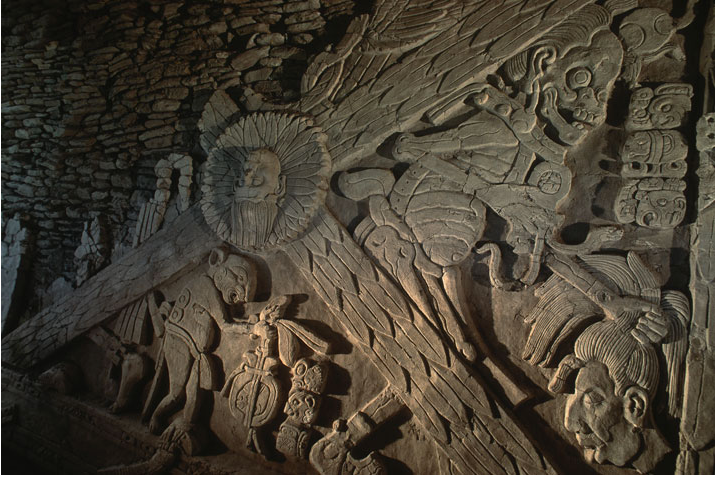
Mayan Civilisation : Carvings


From top to bottom:

1. Commissioned by a Tikal ruler named Stormy Sky, an inscribed stone pillar known as Stela 31 tells of Fire Is Born’s arrival years before—and the death that same day of Tikal’s king, surely ordered by the conquering warlord. When this monument was discovered in 1960, Maya writing was just starting to be deciphered, so Fire Is Born’s name glyph (above left) was first read as Smoking Frog—a simple description of the design. Since then the Maya code has been cracked more fully, and Stela 31 has revealed its long-held secrets.

2. In a terrifying expression of royal power, a stucco mural at Toniná shows a turtle-footed skeleton grabbing the hair of a severed head—with portrait-like features, perhaps of a real person—and a mythical rodent holding another head in a ritual bundle. These characters were the wayob, the affliction-spewing alter egos of kings that were used to curse enemies. They work here amid a scaffold bearing the heads of human sacrifices.

3. One of the last great kings of Cancuén, Taj Chan Ahk, presides over a ceremony in September A.D. 795 on a recently uncovered masterpiece of Maya art. With hundreds of sites still to be investigated, many more such testaments to the glory of the Maya civilization await discovery.

Wednesday, 15 September 2010

IdN - 15th Anniversary Edition


IdN - IdN Extra

About IdN Extra:
As a continuation of its mission to amplify and unify the global design community, IdN is publishing a series of special editions (entitled IdN Extra) that explore in-depth a particular theme or project.


IdN - 100th Issue


100th Issue Content:

10 DESIGNERS / 10 CURATORS
We have asked 10 top-of-the-class creatives to answer a couple of questions — how do they view today's design scene, and what advice would they offer newcomers to it? Not only that, but our Top 10 have been generous enough to pick out 10 peers whose work they believe deserves greater prominence for your enjoyment. A feast of inspiration, then, for everybody in the art and design business.
Featuring:
Antoine+Manuel | Big Active | eBoy | Maurice Broomfield | Jason Brooks | Paul Budnitz | Stanley Donwood | David Dowton | Non-Format | Genevieve Gauckler | Marcus Hofko aka The Rainbowmondey | John Jay | Jeremyville | kennardphillipps | Elisabeth Kopf | Simon Oosterdijk | Tom Sachs | Stefan Segmeister | Peter Stemmer aka Peekasso | Viktor Timofeev
Contents:
Motion: IdN 100th — Get down, IdN friends, it's party time!
Creative Country: China — Coming to terms with a cultural legacy
Exhibitionism: PICK Me Up — A 'first' for the UK - but it certainly won't be the last
Studio: Toykyo — Made in Belgium, inspired by Japan
Pick of the Month
Specifications:
102 pages
6 varying paper stocks
4C process, spot UV
91 minutes DVD Video included

IdN - DVD Feature


Thursday, 9 September 2010

Mayan Civilisation : Eyewitness Travel


'If you like your Mayan sites tame and manageable, Mexico's Chichen Itza fits the bill, but if you prefer your ruins living, breathing and vertigo-inducing, it has to be Tikal'

If Tikal were a volcano, it would be on perpetual amber alert. You tell yourself that nothing's going to happen whilst you're there, but then again, once there, suddenly you're not so sure. Perhaps it's incessant chattering, rustling wildlife or the feeling that the on-site archaeologists are on the verge of unearthing something spectacular, but this ancient site has the air of a place about to rumble into action at any moment. Whereas better known Chichen Itza can feel a little like a historical theme park, Tikal's winding jungle pathways and remote location combine with its sheer scale to devastating hairs-on-the-back-of-your-neck effect.
At one time the epicentre of the Mayan Civilisation, the city of Tikal dominated Mesoamerica in the 6th Century AD, during the region's late classic period. The most impressive of Tikal's structures are its six huge stone step pyramids, known as Temples I-VI, some of which tower over 61m (200ft) above the humble tourist. Yet the majesty of Tikal is apparent wherever you are, whether you are craning your neck upwards, peering giddily downwards, or gazing across the Plaza Mayor at the temple tops rising above the rainforest canopy.
Much of Tikal remains unexcavated, unlike Chichen Itza, which was fully cleared in the 1930s and is all the catalogued, on a plate. Tikal leaves much more to the imagination - its ancient ruins are always keeping something back, whether shrouded in dawn mist or covered in tropical foliage. And when you've found yourself a spot in which to sit and take it all in, Tikal allows you to believe that if you closed your eyes and drifted into a daydream, you might open them again too find yourself in the midst of a Mayan ceremony; an ancient ball game, perhaps, or a shamanic ritual. It's almost as though the Maya had downed tools and left this, their largest city, just hours before your arrival.
While Chichen Itza has played home to concerts, Tikal has played host to sacred rituals and traditions since the 1990s. During modern Mayan ceremonies, huge fires are lit in Plaza Mayor, and the spirits are recalled to this once powerful citadel, which to this day, although ruined, is far from being spoilt